


AWS has built and tested an AI game-testing agent with Amazon Bedrock that can carry out QA checks inside a Unity game on a physical Android device. Across 11 prepared scenarios, the agent made more than 150 tool calls, caught a deliberate damage error, and stopped after determining that one objective couldn’t be completed.
The prototype was created for the centralized QA team at an unnamed major game publisher. Some build cycles required more than 10 hours of manual testing. It places AWS cloud infrastructure directly inside the development process, with Amazon Bedrock guiding the agent and AWS Device Farm connecting it to the test device. Repeatable checks could then be handled by the agent while human testers concentrated on exploratory work and difficult edge cases.




AltTester exposed the Unity game’s internal state, while a rule-based filter reduced more than 1,400 scene objects to roughly 42 needed for the current task. Amazon Nova summarized that smaller set before Anthropic Claude selected the next action through Amazon Bedrock.
Amazon Bedrock Agent Tests A Live Unity Game
The unnamed turn-based mobile strategy game remained active on a physical Android device through AWS Device Farm. After each action, the agent compared the game state before and after the move to determine whether anything had changed.
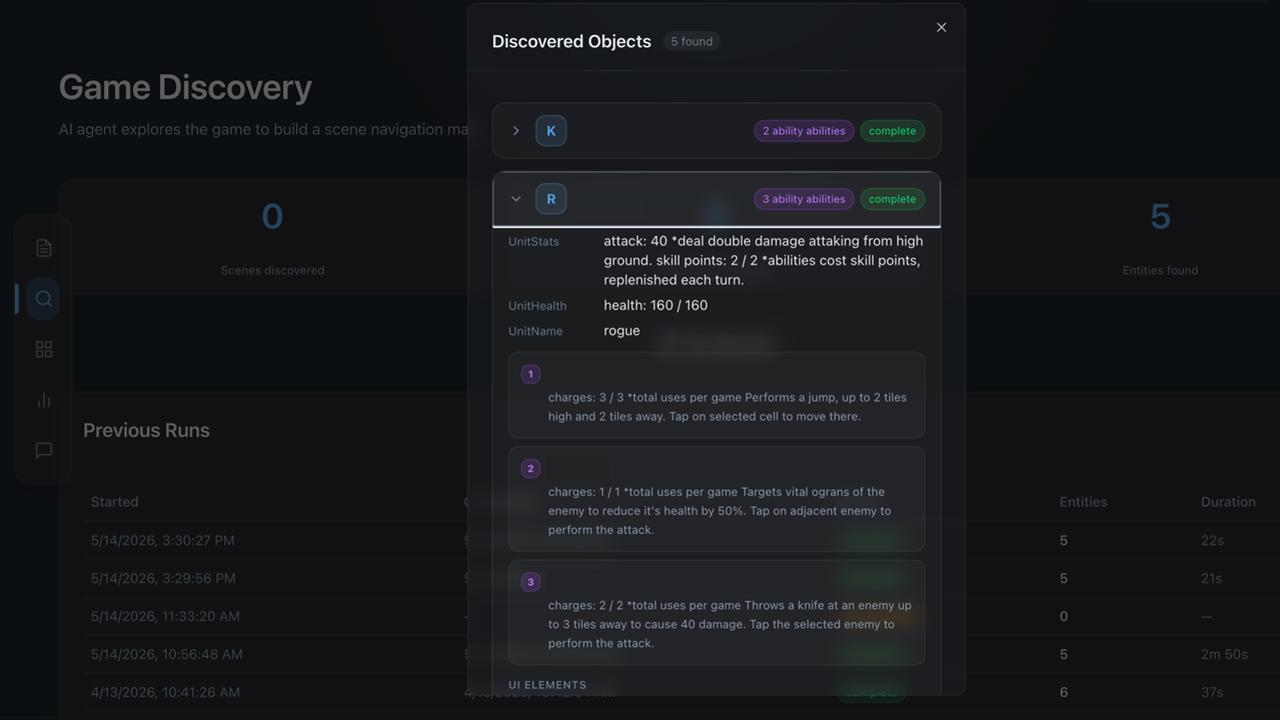
Direct access through AltTester let it check values that screenshots alone wouldn’t expose, including health, ability charges, interface text, and valid movement tiles. That information let the agent verify whether an attack, movement command, or other action produced the expected result.
The agent drew from 13 parameterized tools. One retrieved game context, one handled taps, and another recorded whether a test passed or failed. Game-specific names and instructions stayed in an Amazon Bedrock Knowledge Base, so the individual tools didn’t need to be rewritten for every test. QA staff could also edit 10 prompt templates through a browser interface. Those changes adjusted how the agent interpreted game state, chose its next action, and responded when it stopped making progress, all without changing the underlying code.
The Agent Catches A Damage Error And Stops An Impossible Test
The prepared scenarios ranged from short checks of game statistics to multi-turn combat objectives requiring as many as 50 steps. One test contained a deliberate damage error. The agent compared the recorded damage with the expected value, recognized the mismatch, and failed the test.

Another scenario gave it an objective that couldn’t be completed. A Python check reviewed the previous 10 actions for repeated calls or moves that caused no change. Claude then received another opportunity to change its approach. After the stuck-state check triggered three times, the agent stopped and recorded the test as failed. That prevented it from repeating the same commands indefinitely.
AWS Estimates Monthly Costs For Larger Test Suites
Prompt caching reached a hit rate above 50 percent and reduced cached-token costs by 90 percent during the prototype tests. AI model costs averaged about $0.20 per test, with one more complicated scenario reaching about $0.28.
The wider deployment estimates were much higher because they included fixed infrastructure. AWS calculated approximately $760 per month for 50 nightly tests and $1,665 per month for 200 nightly tests. AltTester Pro licensing and AWS Device Farm use would also need separate management.
The published results came from an unnamed turn-based mobile strategy game tested under controlled conditions. Larger games would require more tools, revised prompts, and additional ways for the agent to interpret what was happening. AWS plans to publish the framework on GitHub, giving development and QA teams a closer look at how the agent was assembled and where the approach could go next.
As always, remember to follow us on our social media platforms (e.g., Threads, X (Twitter), Bluesky, YouTube, and Facebook) to stay up-to-date with the latest news. This website contains affiliate links. We may receive a commission when you click on these links and make a purchase, at no extra cost to you. We are an independent site, and the opinions expressed here are our own.