


Cloud gaming headlines often focus on the biggest ecosystems, but stories like Boosteroid’s cloud gaming expansion are the ones that actually reshape how the industry grows. A recent WhiteFiber case study examining Boosteroid’s expansion reads less like a presentation and more like a blueprint for how an independent platform can scale without being backed by a megacorp. It lays out how Boosteroid went from a regional provider to a service supporting millions worldwide, and it caught my attention because it shows that cloud gaming does not only move when giants like Xbox or Nvidia do.
The surprising part is how the infrastructure came together. Boosteroid used a financing framework through WhiteFiber that unlocked $700M to deploy custom AMD and ASUS-based server fleets across Europe, North America, and South America. Seeing an independent provider reach 7.8 million users in 2025 through that kind of buildout tells a different story about cloud adoption than we usually hear. It presents a model that adapts instead of attempting to imitate hyperscalers.

This connects well with cloud gaming’s promise of access without hardware barriers. Rather than mirroring console ecosystems, Boosteroid expanded by increasing capacity across regions included in the case study. It feels like one of those turning-point examples you remember, especially if you want cloud gaming to stay open, portable, and not tied to a single device.
Funding and Growth
The case study highlights a side of cloud gaming we rarely see up close. Boosteroid’s growth needed more than demand. It needed capital and hardware availability that matched it. WhiteFiber provided a financing framework that unlocked $700M for infrastructure, and that number is presented as the turning point. It let Boosteroid order and deploy large batches of custom ASUS and AMD servers, which became the backbone of the expansion.
According to the report, this collaboration enabled Boosteroid to reach 7.8 million users in 2025 and positioned the company on a trajectory toward supporting an estimated 100 million users between 2032 and 2035. Those targets are framed as proof that an independent service can scale when it has the financing to match its ambitions.
What stands out to me here is how different this approach feels compared to the bigger cloud ecosystems. Those companies grow through integration across hardware and software platforms. Boosteroid scaled by buying time and equipment to serve demand directly. It reads like a reminder that growth in cloud gaming is not only about first party ecosystems or subscription bundling. It can also come from financing, partnerships, and a willingness to place infrastructure where people already want to play.
Hardware and Performance
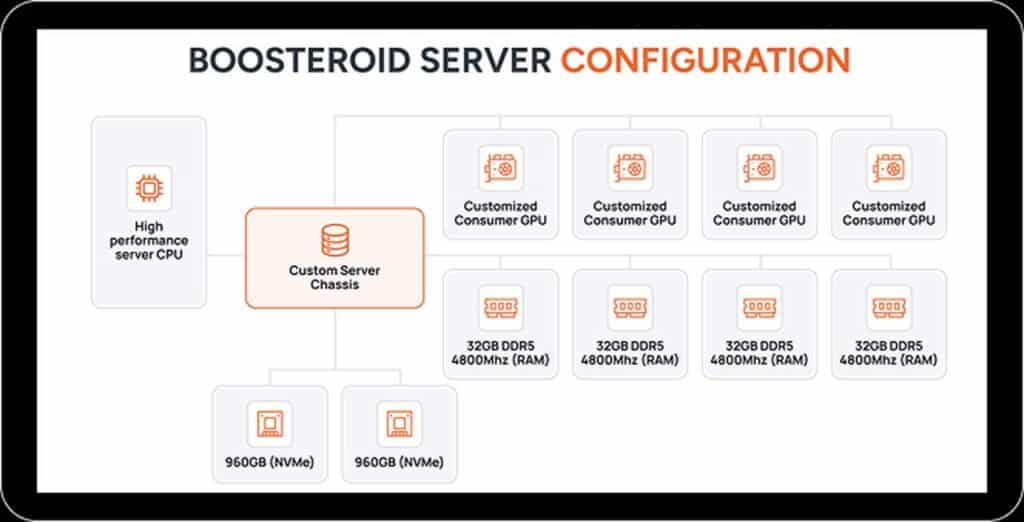
The hardware story in the case study is surprisingly practical. Instead of leaning on traditional hyperscaler cloud stacks, Boosteroid built a custom configuration around AMD consumer-grade GPUs housed in ASUS-engineered server units. The report explains that these designs were tailored for gaming workloads rather than generalized compute, which makes sense when cloud gaming success depends on responsiveness and image quality.

The idea is simple. Consumer GPUs offer the performance features that gaming relies on, including visual sharpening, frame generation, and resolution tools. WhiteFiber’s financing allowed Boosteroid to acquire and deploy these units at volume. The case study ties this directly to Boosteroid’s ability to offer 4K streams and 120 frame-per-second sessions across supported titles. Those targets often feel theoretical in cloud gaming discussions, so seeing them positioned as achievable outcomes stood out.
ASUS handled the server architecture. The report describes their work as chassis design, component integration, and thermal tuning aimed at scale deployment. As someone who follows cloud gaming closely, it is interesting to see consumer-grade GPUs used as the backbone instead of datacenter cards. It illustrates how gaming workloads can be served through consumer-grade GPUs rather than traditional enterprise cards, according to the case study. This also hints at why Boosteroid can compete on performance without owning a console or a flagship PC platform.
Regional Deployment and Accessibility
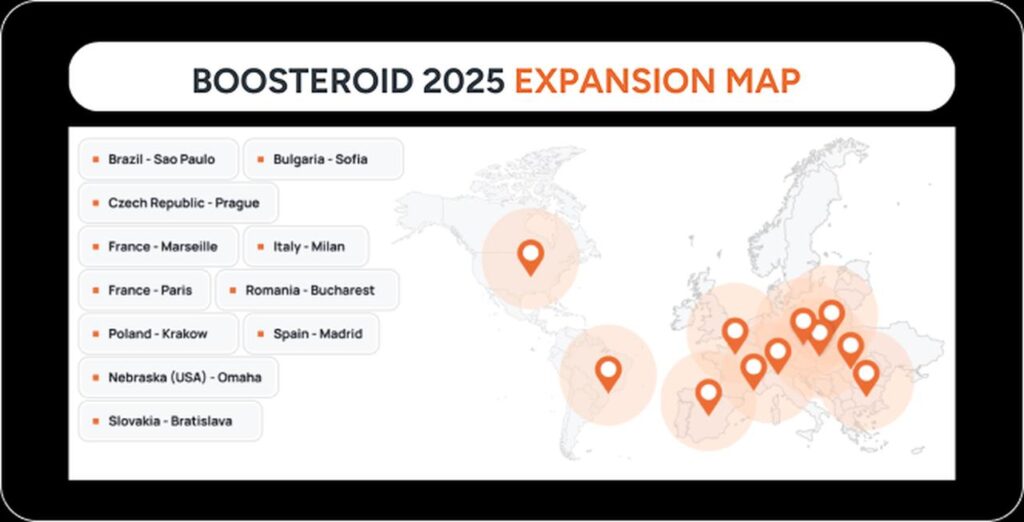
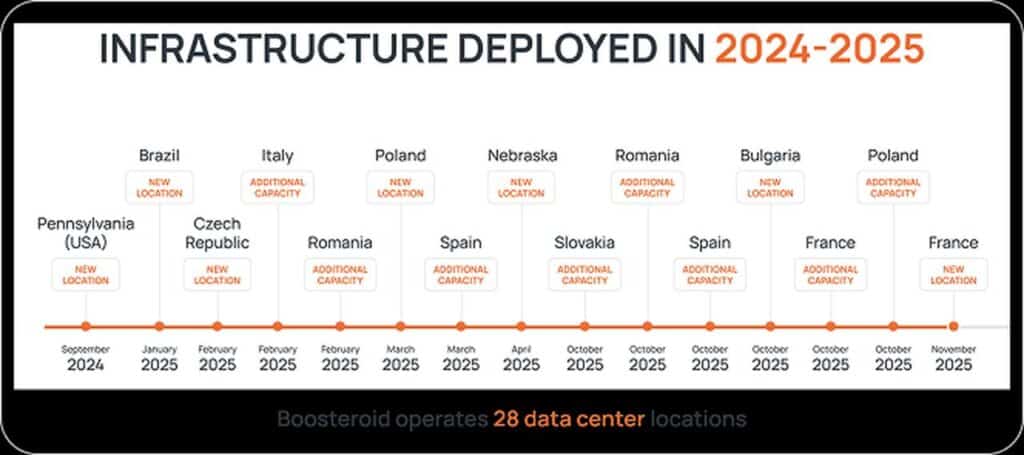
The report places a lot of weight on how fast Boosteroid could move once financing was secured. It states that the time needed to acquire and install new servers dropped by fifty percent. That detail connects directly with their geographic rollout. The expansion includes new builds in the United States, Brazil, and Poland, along with reinforcement of existing territories. Each location is presented as part of a broader plan where hardware sits closer to users, which helps keep latency down.
This is where the case study ties infrastructure to accessibility. Boosteroid is not chasing exclusivity. It is trying to lower the barrier for people who do not own gaming hardware. That strategy fits cloud gaming’s pitch whether you stream on a laptop, smart TV, or mobile screen. The faster Boosteroid can stand up new data centers, the smoother that experience becomes. Seeing regions highlighted where console and PC availability can be uneven made the point land for me.
From a Cloud Dosage perspective, this aligns with the idea that cloud services grow by showing up where demand already exists rather than assuming it will build later. It also reflects that independent platforms do not need to mirror Big Tech ecosystems to expand. They can grow by being available, responsive, and flexible to regional needs. The case study frames this approach as part of Boosteroid’s ongoing scaling strategy.
Boosteroid’s Expansion Shows Where Independent Cloud Gaming Can Go
Reading through WhiteFiber’s case study on Boosteroid feels different from typical cloud gaming news. It gives a clearer picture of how an independent platform can scale when it has the capital support. And hardware strategy to match its demand. Boosteroid’s use of consumer-grade AMD GPUs, custom ASUS server designs, and location-focused rollouts shows that cloud gaming can grow without owning hardware ecosystems or entertainment platforms. The case study frames this as growth driven by infrastructure availability.
That idea aligns with cloud gaming’s original appeal. It opens access for people who do not want or cannot buy local gaming hardware. The case study positions Boosteroid’s projection toward supporting up to 100 million users in the early 2030s as part of its long-term trajectory. The case study links financing and scalable infrastructure to reaching more users.

As someone who follows cloud gaming closely, what stands out here is that this case study tells a story that is not centered on platform lock-in. It is centered on building availability and performance wherever people want to play. If more companies take cues from this approach, cloud gaming could shift away from closed ecosystems and move closer to the idea of gaming that travels with you. It will be interesting to watch whether Boosteroid’s path becomes a reference point for others aiming to grow in the same way.
As always, remember to follow us on our social media platforms (e.g., Threads, X (Twitter), Bluesky, YouTube, and Facebook) to stay up-to-date with the latest news. This website contains affiliate links. We may receive a commission when you click on these links and make a purchase, at no extra cost to you. We are an independent site, and the opinions expressed here are our own.