


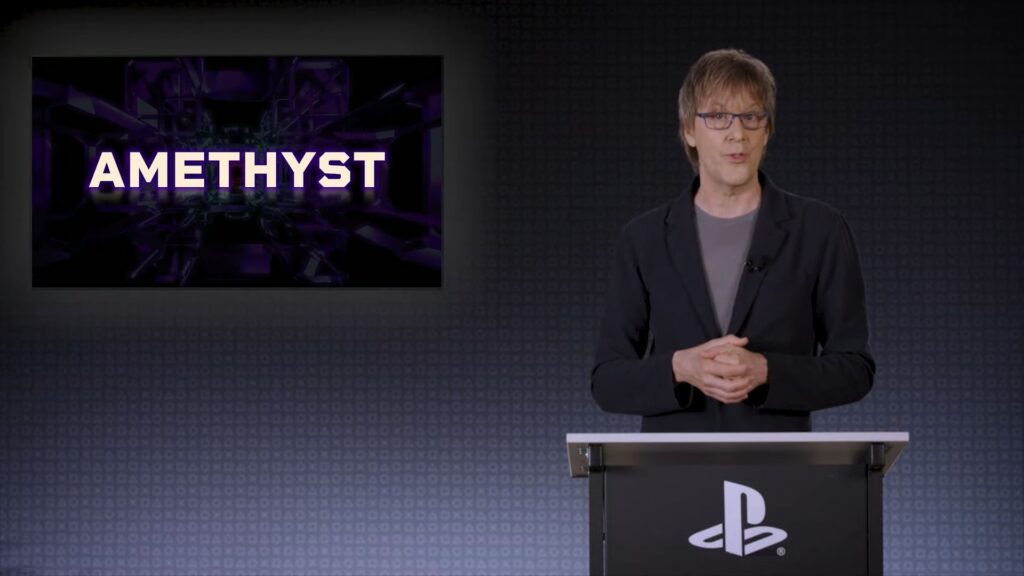
AMD and Sony Interactive Entertainment have teamed up once again to talk about the future of gaming technology, and this time it’s bigger than any console reveal. In a new video titled From Project Amethyst to the Future of Play, AMD’s Jack Huynh, Senior Vice President and General Manager of the Computing and Graphics Group, sits down with Mark Cerny, Lead Architect of PlayStation 5 and PlayStation 5 Pro, to unpack a series of breakthroughs born from their latest collaboration, Project Amethyst.
Cerny calls Project Amethyst an ongoing partnership focused on machine-learning-based technologies that improve both graphics and gameplay. Instead of relying purely on raw power, the goal is to make rendering smarter by using AI to manage real-time lighting, physics, and world detail without wasting performance. Huynh adds that these efforts build on previous co-engineering behind AMD’s FSR (FidelityFX Super Resolution) and Sony’s PSSR (PlayStation Super Resolution), two systems that already use neural networks to boost clarity and frame rate.




The video highlights three major innovations: NeuroArrays, Radiance Cores, and Universal Compression. Each is designed to push GPU performance and efficiency in new directions. While the technology’s still early, both leaders stress that these advances could shape how future consoles, PCs, and even cloud platforms render games in real time.
Huynh sums it up nicely. AMD and Sony want these breakthroughs to reach every gaming platform, showing that Project Amethyst isn’t just about the next PlayStation. It’s about the future of play for everyone.
What Is Project Amethyst?
Project Amethyst is the latest phase in the long-running collaboration between Sony Interactive Entertainment and AMD, designed to push gaming technology beyond traditional hardware scaling. In the video, Mark Cerny describes it as a joint research effort focused on machine-learning-based rendering, system-level efficiency, and new forms of real-time graphics acceleration. Instead of simply increasing GPU power, the goal is to make rendering smarter so every pixel, light source, and texture benefits from neural intelligence.
At its core, Project Amethyst blends two worlds: rasterization, the process that converts 3D objects into on-screen pixels, and neural acceleration, specialized hardware and software that handle complex AI tasks faster. By merging these techniques, Sony and AMD are creating tools that help developers deliver cleaner visuals, smoother gameplay, and richer detail without added strain on hardware.
Cerny points to FSR and PSSR as early examples of what this partnership has already produced. Both technologies use trained neural networks to upscale images in real time, preserving detail while maintaining performance. Project Amethyst builds on that foundation and serves as the umbrella for a new generation of AI-enhanced rendering that could influence everything from future PlayStation consoles to PC and cloud gaming.

Huynh emphasizes that AMD and Sony’s shared goal is to bring these breakthroughs to developers across every gaming platform. This collaboration isn’t limited to one ecosystem. It’s part of a larger effort to push gaming technology forward for everyone.
NeuroArrays: AI Engines Inside the GPU
One of the biggest breakthroughs highlighted in the discussion is something AMD and Sony call NeuroArrays, a new way of designing how GPUs handle machine-learning tasks. Traditionally, a GPU is made up of dozens or even hundreds of compute units, each processing a small piece of a larger workload. That approach works well for graphics but becomes inefficient when running neural-network operations, which rely on shared data and tight coordination.
NeuroArrays rethink that structure. Instead of letting every compute unit work on its own, AMD and Sony found a way to link them together into collaborative clusters that process data like a focused AI engine. The result is a system that can handle larger and more complex machine-learning models directly on the GPU, without constantly sending data back and forth to memory.
For developers, this means better performance and scalability for features such as upscaling, denoising, and real-time lighting reconstruction. For players, it translates into smoother gameplay and richer detail, especially in games that rely on AI to render large, dynamic worlds.
Huynh and Cerny describe NeuroArrays as the foundation for the next wave of neural rendering, a smarter and more efficient way to generate frames that could power everything from PlayStation’s future hardware to cloud-based rendering pipelines and other AMD-powered platforms. It reflects AMD and Sony’s shared goal to make these breakthroughs available across every gaming platform, uniting console and PC development under one vision of smarter graphics technology.

Radiance Cores: Dedicated Path-Tracing Hardware
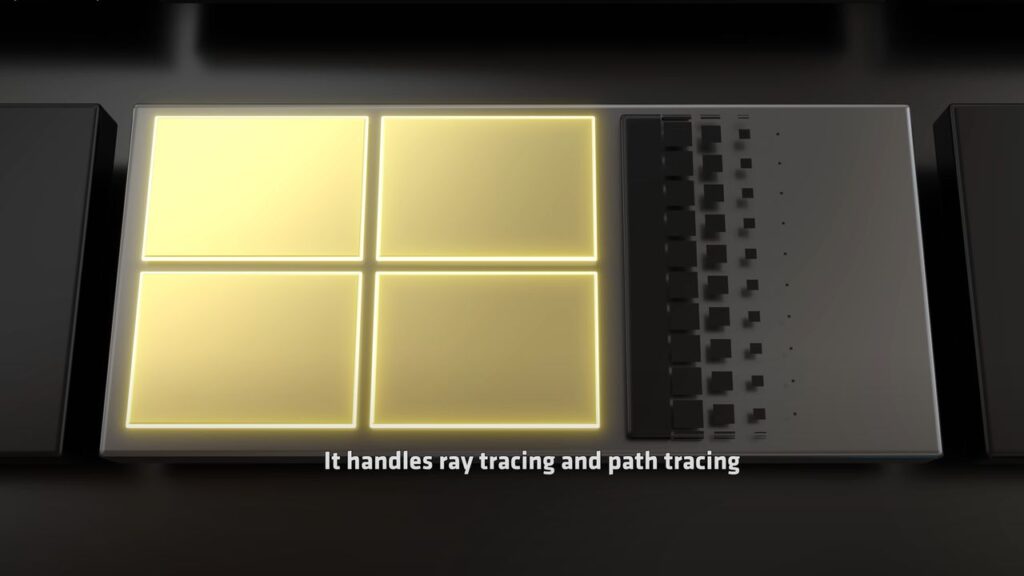
The second major breakthrough revealed in the discussion is Radiance Cores, a new hardware block built to handle the most demanding part of modern rendering: ray tracing and path tracing. Ray tracing simulates how light interacts with objects in a 3D scene to produce realistic reflections, shadows, and illumination. Path tracing takes that idea further by calculating how light bounces and scatters across an entire environment, creating more lifelike lighting but requiring far more computational power.
Cerny explains that current GPUs struggle with this because the same shader program has to perform two jobs at once. It must trace millions of light rays through complex data structures while also shading the results to create the final image. Radiance Cores separate those tasks. They take over ray traversal, the process of finding where rays hit geometry, freeing the GPU’s main shader units to focus purely on lighting and texture work.

The result is a far more efficient rendering pipeline capable of cinematic lighting in real time. AMD has already taken early steps in this direction with Neuro Radiance Caching, part of its FSR Redstone initiative. Radiance Cores go even further by integrating that logic directly into hardware, enabling faster, cleaner, and more scalable lighting systems.
Cerny says he is eager to see how developers use these tools once Radiance Cores reach future PlayStation hardware and beyond.
Universal Compression: Smarter, Faster, More Efficient
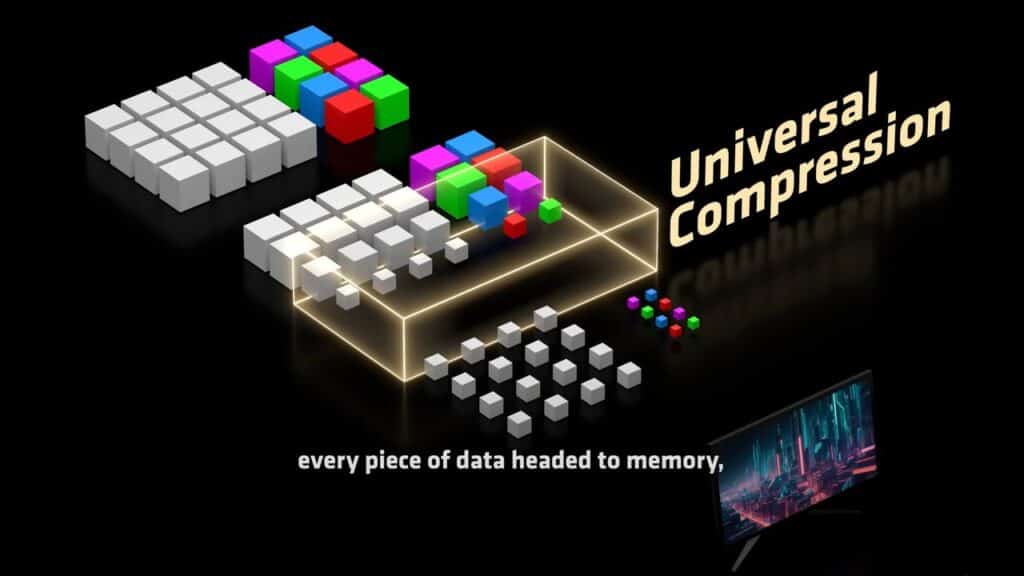
The third breakthrough introduced under Project Amethyst focuses on something less visible but just as important, memory bandwidth. Even the most powerful GPUs are limited by how quickly they can move data between memory and the processor. To solve this, AMD and Sony have developed a new system called Universal Compression, which dramatically improves efficiency across the entire rendering pipeline.
Today’s PlayStation hardware already uses DCC (Delta Color Compression) to reduce bandwidth use when handling textures and render targets. Universal Compression takes that concept much further. Instead of compressing only color data, it evaluates every piece of data headed to memory, finding what can be reduced before it is sent out. The GPU then processes only the essential bytes, cutting down on memory traffic, power consumption, and heat while maintaining visual quality.
Cerny notes that this innovation could allow future GPUs to deliver higher frame rates, more detailed assets, and better energy efficiency. It also complements the other Project Amethyst technologies. NeuroArrays benefit from faster data flow, while Radiance Cores gain smoother access to lighting information.
Although Universal Compression is still in simulation, the early results are promising. Both Cerny and Huynh believe it could become a cornerstone for next-generation GPUs, helping games look sharper and run faster across consoles, PCs, and cloud platforms.
Beyond Consoles: What This Means for Cloud Gaming and the Wider Industry
While Project Amethyst began as a collaboration between AMD and Sony Interactive Entertainment, both Cerny and Huynh make it clear that its impact will reach far beyond PlayStation hardware. Huynh highlights that AMD’s goal is to bring these innovations to developers across every gaming platform, not just consoles. The same machine learning techniques that will drive future PlayStation experiences could also shape how PC GPUs and cloud servers render games.
The implications are huge for the cloud space. Technologies like NeuroArrays and Universal Compression are designed to make GPUs more efficient, scalable, and power-conscious, all of which are essential for running high-fidelity games on remote infrastructure. As more cloud services rely on AMD-powered data centers, these breakthroughs could help reduce latency, improve image stability, and allow more demanding games to stream smoothly at 4K and beyond.
This isn’t just a win for hardware enthusiasts. It is also a signal that the next generation of rendering will be shared across local and cloud ecosystems. The same AI-driven pipelines that power PS5 Pro’s visuals could eventually enhance performance on streaming platforms and virtualized PCs.

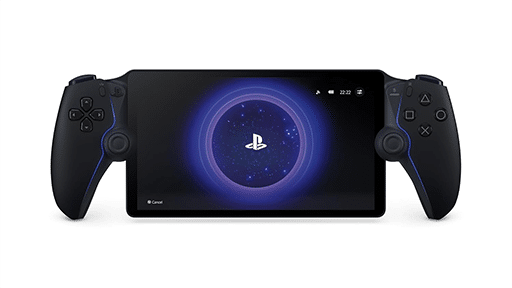

By focusing on smarter, not just stronger, rendering, Project Amethyst points toward a future where console, PC, and cloud development all benefit from the same underlying technology. It is an ambitious step toward a unified vision of gaming, one that truly is for everyone.

The Next Chapter in PlayStation and AMD’s Partnership
Project Amethyst represents more than a set of technical breakthroughs. It is the next step in a partnership that has shaped PlayStation hardware for more than a decade. From the PS4’s custom AMD APU to the PS5 and PS5 Pro’s RDNA-based architecture, Sony and AMD have consistently focused on hardware that balances performance with creative flexibility. With Project Amethyst, that collaboration is expanding into machine-learning-driven rendering and smarter GPU design.
Cerny notes that Universal Compression is still in simulation for now, but the early results are promising. He adds, “I’m really excited about bringing them to a future console in a few years’ time.” It is a rare glimpse into how far ahead Sony and AMD are planning and how closely they are working to shape that future together.
Huynh closes the discussion by reinforcing that these advances are not just for PlayStation. They are part of a shared mission to push gaming technology forward for everyone, whether you are playing locally or through the cloud.
If Project Amethyst is any indication, the next generation of gaming will not just be about faster hardware. It will be about smarter, more adaptive technology that benefits every player on every platform.
As always, remember to follow us on our social media platforms (e.g., Threads, X (Twitter), Bluesky, YouTube, and Facebook) to stay up-to-date with the latest news. This website contains affiliate links. We may receive a commission when you click on these links and make a purchase, at no extra cost to you. We are an independent site, and the opinions expressed here are our own.