


UNBEATABLE doesn’t take long to show you what kind of game it is. From the first few minutes, it’s clear this is a rhythm game that puts just as much weight on style, characters, and atmosphere as it does on hitting notes on time. Music isn’t just a mechanic here. It’s baked into how the world works and how the story moves forward.
At a high level, UNBEATABLE is split between two distinct experiences. One is its rhythm gameplay, built around quick reactions, pattern recognition, and a simple control scheme that becomes demanding as songs ramp up. The other is a story mode that spends a lot of time outside those musical encounters, letting you walk, talk, and move through its world between bursts of action. Sometimes those two sides work well together. Other times, they feel slightly out of step.
After spending time with both the story mode and the arcade-focused side, UNBEATABLE comes across as a game with a strong identity and a willingness to do things its own way. It doesn’t always move at the pace you might expect, but when the rhythm gameplay takes centre stage, it’s easy to see what keeps pulling you back in.
A Story Built Around Waiting for the Next Song
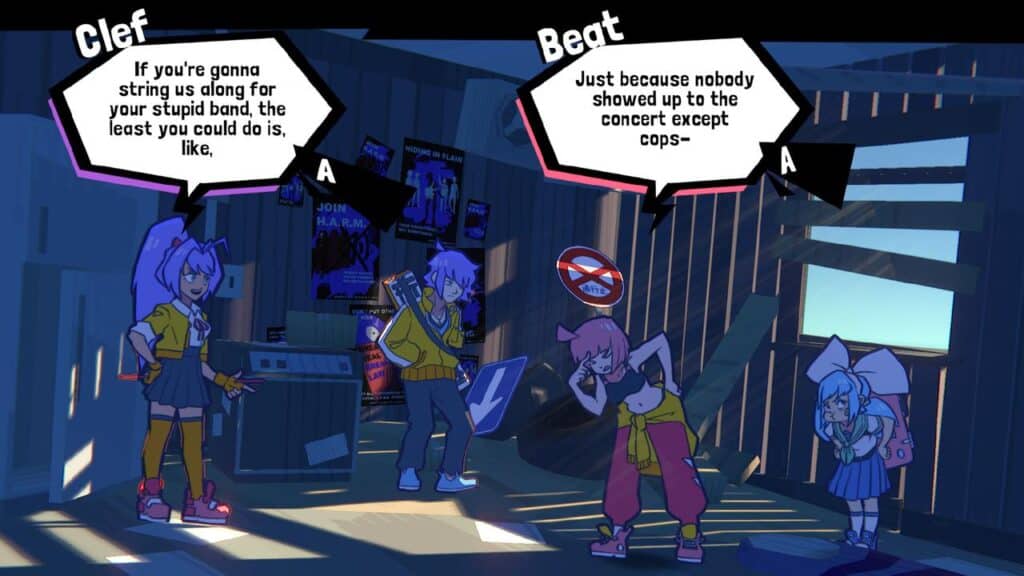
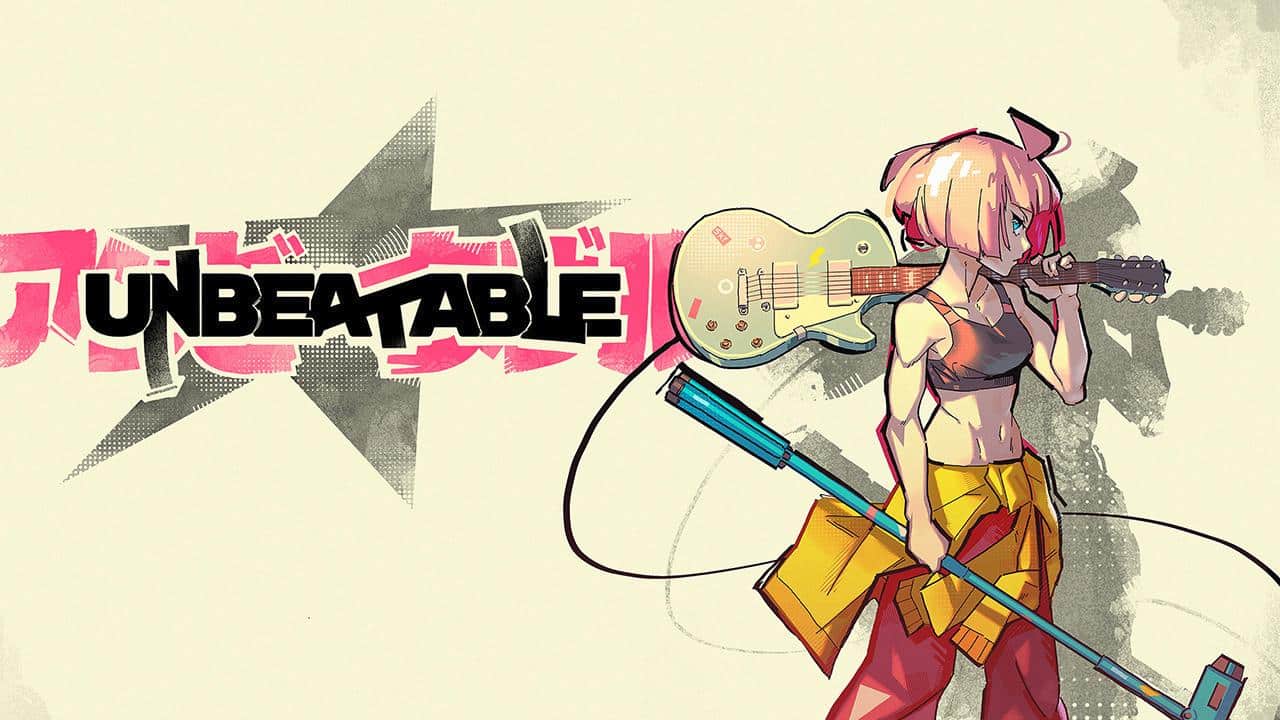
UNBEATABLE’s story mode is where the game slows things down, for better and for worse. You play as Beat, a musician in a world where music has been outlawed, moving from place to place as she connects with Quaver, Clef, and Treble while trying to keep creating in a space that pushes back against it. The setup is easy to follow, and it doesn’t rush explanations.
A lot of the story’s strength comes from its characters and their interactions. Conversations often carry a dry, understated tone, and the cast plays off each other in ways that help the slower sections feel more intentional. When the writing focuses on small exchanges or personal frustrations, it tends to land better than when it tries to juggle bigger plot beats.
Where the story mode starts to struggle is pacing. There can be long stretches without rhythm gameplay, replaced by walking, dialogue, and light interaction. Some of these sections help flesh out the world, but others mainly bridge the gap between musical set pieces. It’s not uncommon to go a while before the next rhythm encounter shows up, which can make the overall flow feel uneven.
Not every gameplay idea introduced in story mode hits the same way. Alongside the main rhythm combat, there are smaller activities and minigames that mix things up. A few are fun distractions, but others don’t feel as tightly tuned as the core rhythm gameplay, adding to that stop-and-start feel.

The story unfolds over several chapters and takes time getting where it’s going. The back half is more focused than the opening hours, but the slower build asks for patience. If you’re mainly here for the rhythm gameplay, story mode can feel like a long road between highlights.
Two Buttons, Four Directions
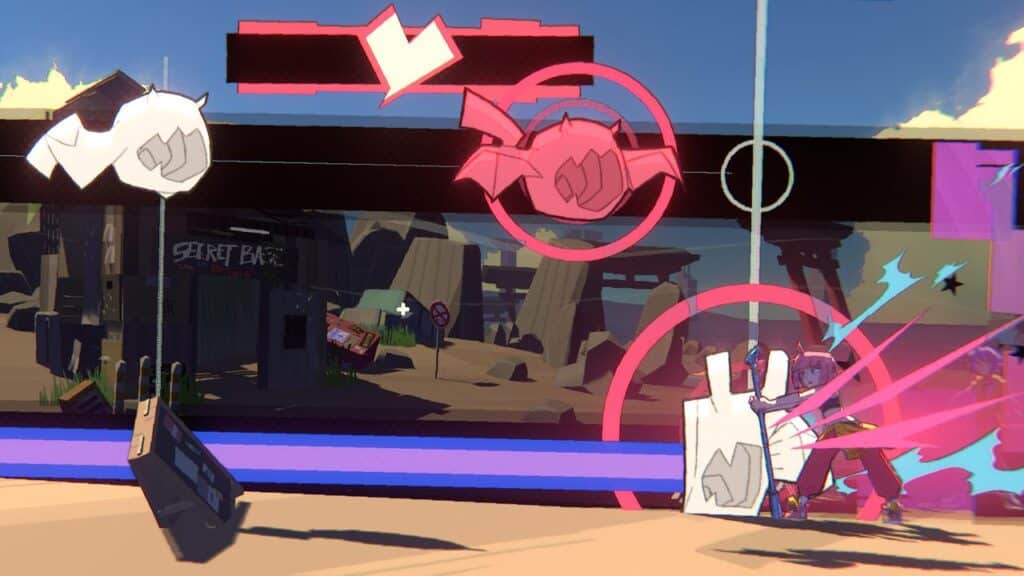
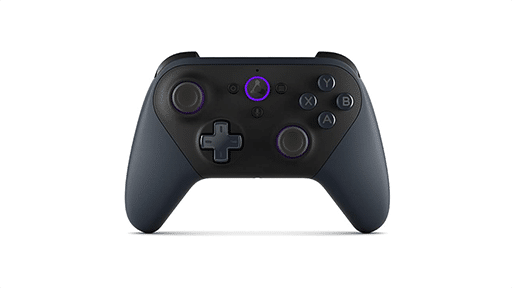
At its core, UNBEATABLE’s gameplay revolves around a deceptively simple rhythm system. Most encounters ask you to focus on two horizontal lanes, one above Beat and one below her, with incoming prompts moving toward the centre in time with the music. Each lane is tied to a single input, which keeps the control scheme easy to grasp while still leaving room for complexity as songs speed up.
What makes this approach work is how much it asks you to read patterns rather than individual notes. Enemies can arrive from different directions, overlap in timing, or shift lanes mid-sequence. On lower difficulties, this gives you time to adjust and learn how the game communicates its rhythms. As difficulty increases, those same patterns demand quicker reactions and more consistent timing, without changing the core rules you’ve already learned.
Combat is framed around striking enemies to the beat, but it never feels disconnected from the rhythm itself. Hits land cleanly when your timing is right, and misses are easy to understand when they happen. Inputs felt reliable, and mistakes were down to my own timing rather than unclear feedback. That consistency makes retrying songs feel fair instead of frustrating.
UNBEATABLE also adds small variations to keep things from becoming monotonous. Some enemies trigger follow-up actions across lanes, while others require repeated inputs or avoidance instead of direct hits. These additions don’t overwhelm the player, but they do force you to stay alert and adapt as songs progress. The result is a rhythm system that stays engaging over longer play sessions without becoming exhausting.
When everything clicks, the rhythm gameplay becomes the most consistent and satisfying part. It’s a system that rewards learning, repetition, and focus, and it forms the foundation that both the story mode and arcade mode build on in different ways.
Where the Rhythm Stays Front and Centre
Arcade mode strips UNBEATABLE back to its most consistent elements. Instead of moving between story scenes and locations, you jump directly into songs and focus entirely on the rhythm system. If you’re mainly here for the gameplay, this is where the game feels the most comfortable and focused.
The mode offers a wide selection of tracks pulled from across the game, along with additional songs that aren’t tied to story progression. Each track can be played across multiple difficulty levels. This lets you ease into the system or push yourself as patterns become faster and more demanding. Because the rules never change, improvement comes from familiarity and timing rather than learning new mechanics every few songs.
Arcade mode also focuses heavily on replayability. Chasing higher scores, cleaner runs, and tougher difficulties gives you a clear reason to revisit tracks. Cosmetic unlocks and profile customization add a bit of personal flair, but the real pull comes from mastering songs that initially feel just out of reach.
Without the interruptions found in story mode, the rhythm gameplay has room to breathe. Patterns are easier to read, mistakes are easier to learn from, and the overall flow feels more consistent from start to finish. It highlights how well the core system holds up on its own and makes a strong case for arcade mode as the way many players will spend most of their time with UNBEATABLE.
A World That Never Stops Looking Like Itself
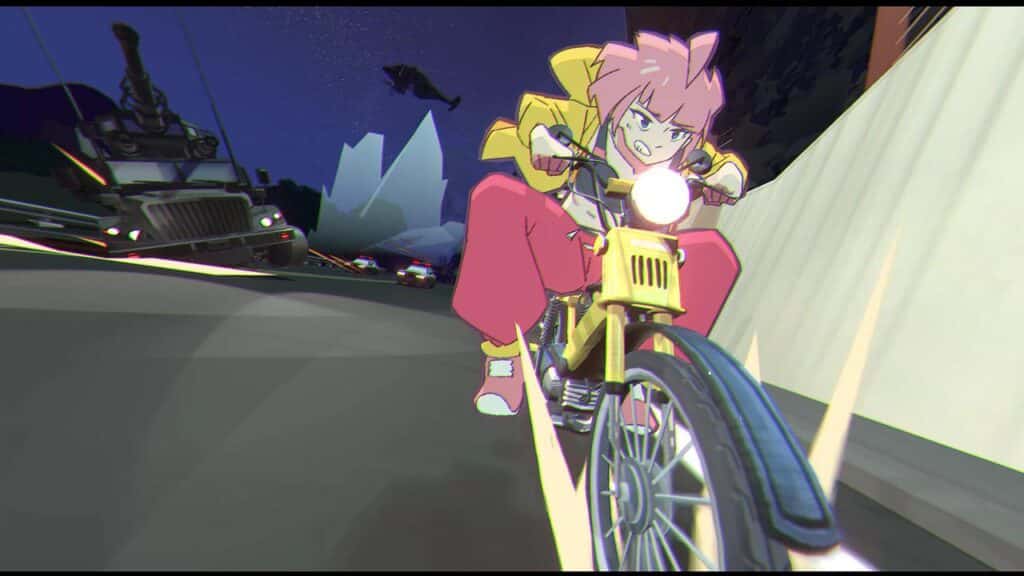
UNBEATABLE’s presentation is one of the most consistent parts of the experience. The game blends flat, anime-inspired 2D character art with fully 3D environments, and the contrast is immediately noticeable. Instead of clashing, the two styles work together to keep characters readable. While letting the world around them feel grounded and lived in.
Character designs are expressive without being overworked. Animations are sharp and easy to read. Whether you’re standing around during dialogue or reacting to incoming prompts during rhythm sections. Facial expressions, posture, and movement do a lot of the work in selling personality, even when scenes are relatively static.
The environments themselves are smaller in scope, but visually distinct. Locations rely heavily on colour, lighting, and framing rather than sheer size, which helps keep navigation clear even when revisiting areas. Nothing feels visually noisy, and important points of interest usually stand out without needing explicit markers.
During rhythm gameplay, presentation stays functional. Effects are stylised but restrained enough that they don’t interfere with reading patterns or timing inputs. Enemy designs, lane indicators, and motion effects remain legible even as songs speed up, which is essential for a game built around quick reactions.
Music sits at the centre of UNBEATABLE’s experience, and the soundtrack is built with the rhythm system in mind. Tracks are structured to keep patterns easy to follow as songs increase in speed, with clear beats that support both learning and mastery. While not every track stands out equally, there’s enough variety to keep longer play sessions from blending together.
Performance is solid where it counts. Rhythm sections feel responsive, timing stays consistent, and misses come down to your own inputs. Story sections have a few rough spots here and there. Nothing game-breaking, but enough to break the flow once in a while.
UNBEATABLE Hits Hardest When You’re Just Playing the Songs
UNBEATABLE is at its best when it puts rhythm first and lets its gameplay do the talking. The core rhythm experience is easy to pick up. It ramps up naturally as you push into higher difficulties, and stays satisfying the more time you put into it. Arcade mode makes that especially clear. It gives you a clean way to focus on songs, tighten up your runs, and see yourself improve without anything getting in the way.
Story mode is a bit more uneven. The characters and world are interesting enough to keep going. But the pacing doesn’t always line up with the energy of the rhythm gameplay. There are stretches where you spend a lot of time walking and talking before the next musical moment shows up. If you’re mainly here for the rhythm side, those gaps are noticeable.
What helps UNBEATABLE overall is that everything still feels connected. The presentation, soundtrack, and gameplay all point in the same direction, even when rough edges pop up. The game doesn’t keep changing how it works or ask you to constantly relearn things. Instead, it rewards getting comfortable with its patterns, timing, and flow.
If you’re looking for a rhythm game with a strong arcade focus and a style that sticks with you, UNBEATABLE delivers. You’ll get the most out of it by spending time with the songs and being patient with the story mode. When everything lines up, the rhythm gameplay is what leaves the biggest impression.
UNBEATABLE
Summary
UNBEATABLE takes a simple two-button rhythm system and builds its entire experience around mastering patterns and timing. Arcade mode lets you focus purely on the songs, pushing for cleaner runs and higher difficulties, while story mode slows things down with longer stretches between musical moments. The rhythm gameplay stays satisfying as it ramps up, and the game’s visual style holds everything together. If you’re here for a focused rhythm experience and don’t mind a slower story pace, UNBEATABLE delivers where it counts.
As always, remember to follow us on our social media platforms (e.g., Threads, X (Twitter), Bluesky, YouTube, and Facebook) to stay up-to-date with the latest news. This website contains affiliate links. We may receive a commission when you click on these links and make a purchase, at no extra cost to you. We are an independent site, and the opinions expressed here are our own.