


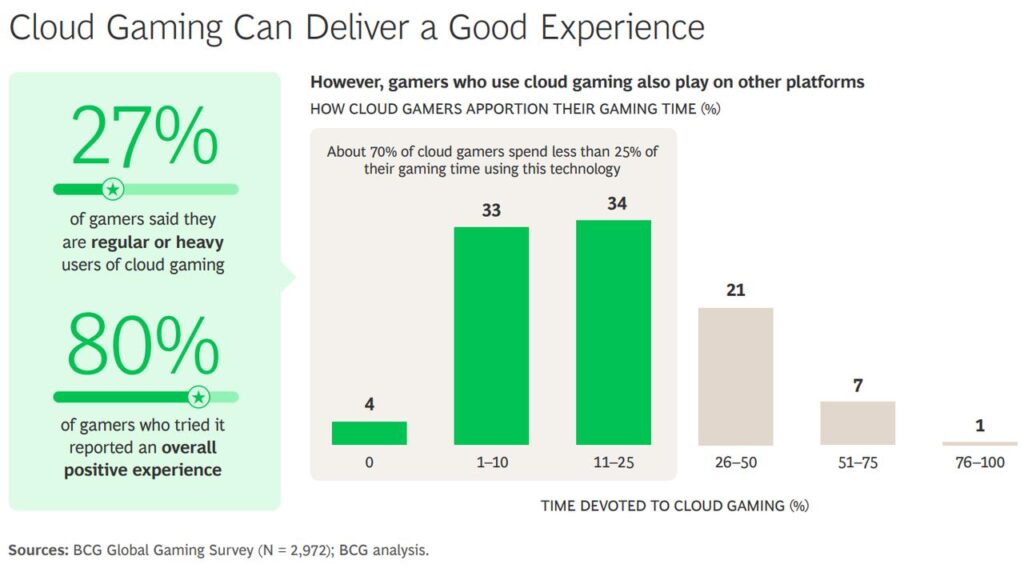
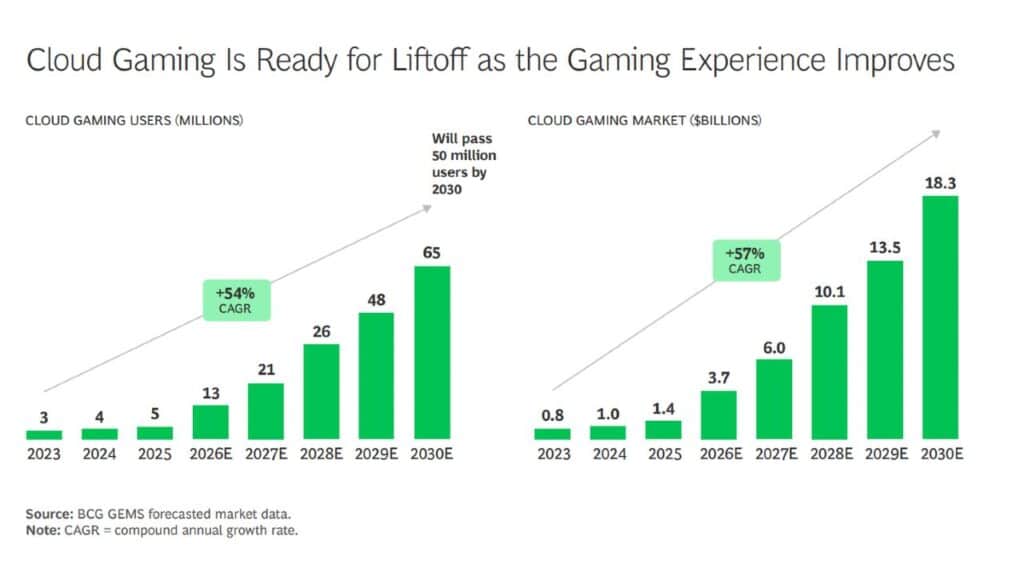
Cloud gaming has always felt like it was on the verge of something big, but it was hard to tell whether the momentum was real or just industry hype. A new Boston Consulting Group report suggests that the moment might actually be arriving. According to the study, global cloud gaming revenue is projected to climb from roughly $1.4 billion in 2025 to $18.3 billion by 2030. That is a huge jump. Even more interesting, about 60 percent of surveyed gamers say they have already tried cloud gaming, and 80 percent of those users reported positive experiences.
So interest is clearly there. You would think that kind of satisfaction would translate into routine use, but only 27 percent identify as regular or heavy cloud gamers. That number is oddly small when stacked against the revenue forecast. It feels like something is missing between curiosity and habit. And honestly, anyone who has tried cloud gaming likely knows why. Cloud gaming is still easy to try but not always easy to stick with. People fall back into established routines, whether that is consoles, PC storefronts, or whatever they grew up with.

BCG frames this moment as the start of a new era. One where platforms collide, distribution shifts, and access becomes less tied to hardware. Still, that usage gap hangs in the air. It raises a simple question worth digging into. If cloud gaming is positioned for explosive growth, what is holding everyday behaviour back?
The Interest Is Real, So Why Doesn’t It Stick?
BCG’s data shows cloud gaming is not suffering from an awareness problem. About 60 percent of surveyed gamers say they have tried it, and 80 percent of those users reported a positive experience. That paints a picture of something people understand and are willing to experiment with. Yet only 27 percent identify as regular or heavy users. Cloud gaming wins the ‘that was cool’ reaction, but not the ‘this is how I play every week’ one.
Why? Behaviour is stubborn. Even with good impressions, most gamers fall back to familiar routines. Console menus, Steam libraries, or mobile apps are comfortable places. They carry purchase history, achievements, communities, and habit loops that cloud gaming still fights to match. Cloud services make jumping in easy, but they do not always make coming back automatic.
There is also friction. Catalog differences, perceived connection instability, or the simple act of remembering which app or TV hub hosts which service can disrupt momentum. None of this means cloud gaming is failing. It just shows that satisfying one session does not automatically rewrite a decade of play patterns.
BCG hints at this indirectly when it notes cloud gaming is “primed for takeoff,” but that momentum depends on something deeper than trial numbers. It requires routine. Until cloud gaming becomes the default place people open without thinking, there is always a gap between interest and loyalty.
Smart TVs, Telcos, and Omniplatform Play Are the Missing Link
BCG believes access is where cloud gaming closes its usage gap. The report points to cloud distribution reducing upfront hardware costs and “expanding access, bringing millions of new players into gaming.” It also notes that gamers will expect their progress and libraries to follow them across screens. That line feels like the foundation for the next five years.
Smart TVs are quietly making that shift real. Services like Blacknut partnering with LG, GeForce Now embedding access through telco networks, Boosteroid embedding cloud access through operator and regional deals, and Xbox slipping into multiple storefronts all help eliminate extra steps. Ubisoft streaming its own titles through Ubisoft Plus Premium fits this shift toward easier access. These moves shorten the path between seeing a game and actually playing it. That matters.
When you do not need a console, upgrade cycle, or dedicated space, cloud gaming becomes easier to use casually. Parents who might not buy another box can still access games. Someone watching TV can try something instantly. And when BCG says cloud will bring millions of new users in, this feels like how it happens.
The interesting question is whether these integrations are enough to shift habits. Convenience can reshape behaviour slowly. It is not flashy, but it chips away at routine. Maybe that is the missing bridge between curiosity and commitment.

The AI Flood and Content Discovery Problem
BCG highlights something that seems unrelated at first but ties directly into cloud adoption. Roughly 20 percent of 2025 game releases disclosed AI usage, and the firm estimates around half of studios use AI in some form. That points to a coming wave of output. Some of it will be impressive, and some will be low-effort “gameslop,” as BCG puts it. The report warns that discovery and curation become far more important in that environment.
Cloud platforms might become the filter. If thousands of cheap, AI-assisted projects flood storefronts, the services that organize, recommend, and surface what is worth your time gain new value. That changes how cloud gaming is perceived. It stops being a utility and starts behaving like a guide.
We already see early signs. Xbox Cloud Gaming bundles first-party catalogues. GeForce Now integrates Steam wishlists and ownership. Blacknut rotates selections and spotlights trials. Ubisoft streams curated internal IP through Ubisoft Plus Premium. These are all curation movements, even if they do not call themselves that yet.
BCG’s point is simple. More content is coming, and someone needs to help you find the good stuff. Cloud services might be where that job lands, and if that happens, discovery alone could start nudging people to use cloud more often.
How the Next Five Years Might Shift Usage Habit
BCG’s forecast ties multiple trends together. If cloud gaming revenue reaches $18.3 billion by 2030 as projected, that growth will not come from a niche audience. It will require people who tried cloud gaming once to start using it without thinking. The report also shows gaming parents introducing kids to games early and playing later into life. Those behaviours support access models that do not rely on hardware cycles.
At the same time, gamers are more price conscious. BCG notes many wait for discounts before buying. Cloud services intersect with that reality by lowering the barrier to trying something new. If a game does not require a download or hardware investment, someone might sample it instead of waiting for a sale.
Even the app store changes BCG points to, where developers can distribute through alternative channels, align with cloud logic. More storefront freedom means more ways to deliver access. That creates an environment where habit change is slow but plausible.
Cloud gaming might not flip overnight. But Smart TVs, curation shifts, generational gaming continuity, and a growing expectation for progress that follows you suggest a gradual move toward convenience-based play. Small nudges add up. Sometimes that is how habits change. If that usage gap shrinks, it will likely come from these subtle pushes rather than a single breakthrough moment.
Cloud Gaming’s Next Step Isn’t Tech, It’s Habit
Cloud gaming looks like it is heading into its make or break stretch. BCG’s numbers suggest it is a lot closer to “make” than many thought. Interest is already there. Sixty percent of surveyed gamers say they have tried it, and most of them walked away with positive impressions. Revenue forecasts jumping from $1.4 billion to $18.3 billion show confidence from the industry side. Yet behaviour lags. Only 27 percent actually describe themselves as steady users.
That gap does not feel like rejection. It reads more like cloud gaming still needs its routine moment. Smart TV integration, Ubisoft streaming its own titles, trials on LG platforms, Boosteroid working with telcos, and GeForce Now living inside hubs all point toward convenience solving that. If cloud becomes the easiest place to try something new, habits will shift one quiet week at a time. You might not even notice it happening.
BCG also hints at something else. As AI accelerates game creation and catalogues swell, discovery becomes just as important as delivery. Cloud platforms could become guides in a sea of content. That role alone could push people to rely on them more.
So maybe this moment is less about proving cloud gaming works and more about helping people make it part of their routine. Do you find yourself defaulting to cloud when you want to try a game fast? Or are you still anchored to console and PC? It will be interesting to see which answer becomes the norm.

As always, remember to follow us on our social media platforms (e.g., Threads, X (Twitter), Bluesky, YouTube, and Facebook) to stay up-to-date with the latest news. This website contains affiliate links. We may receive a commission when you click on these links and make a purchase, at no extra cost to you. We are an independent site, and the opinions expressed here are our own.