



NVIDIA announced DLSS 5 during Jensen Huang’s keynote at GTC 2026 (GPU Technology Conference), the company’s annual AI and technology conference running March 16-19 in San Jose, California. The internet has been arguing about it ever since. Most of the debate has focused on faces. Specifically, whether the photorealistic skin and hair rendering makes games look better or just different. That debate is missing the bigger picture, and for cloud gamers, the bigger picture is genuinely exciting.
DLSS 5 introduces a real-time neural rendering model, which is an AI-driven approach to generating images. It takes a game’s colour and motion vectors (data that tells the AI how pixels are moving between frames) as input, then uses that information to infuse the scene with photoreal lighting and materials. It’s not a filter placed on top of the game. It’s a fundamentally different approach to how the final image gets assembled. The AI model analyses a single frame and recognizes the difference between skin, metal, water, stone, and foliage. It then processes each of those materials differently based on how light should actually interact with them.




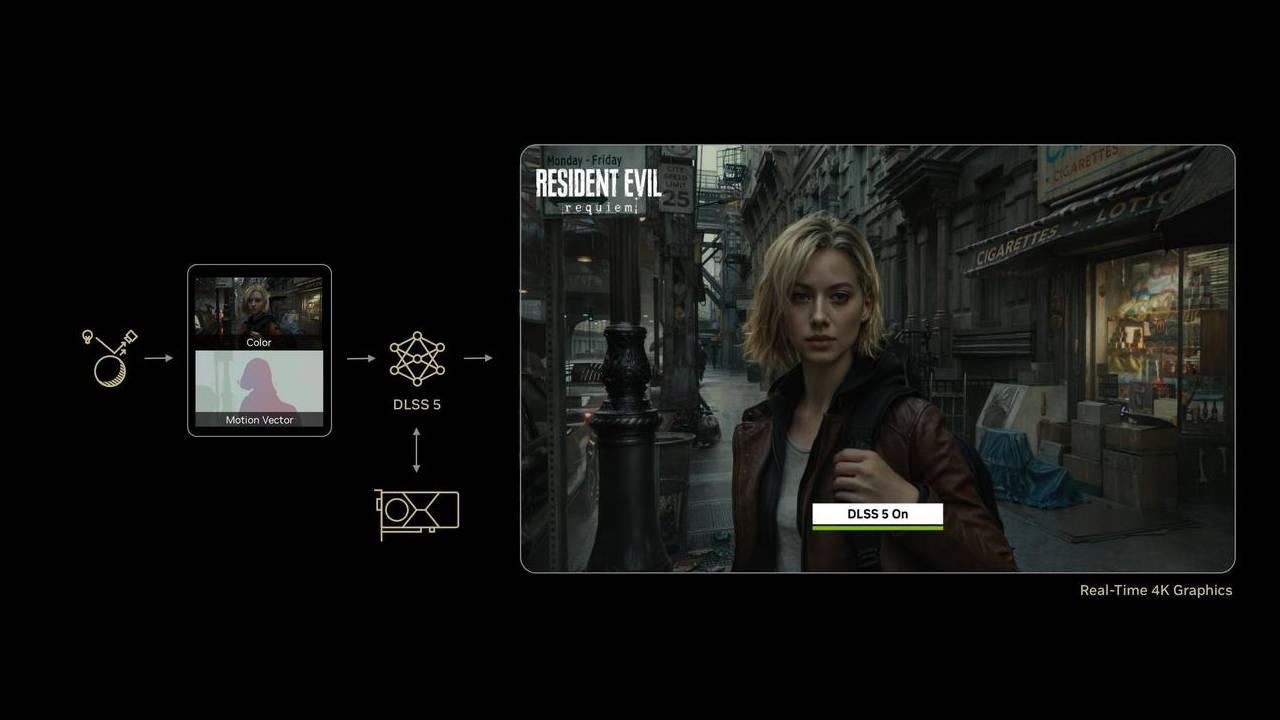
The result is consistent from frame to frame, which is a hard requirement for games. Demos at GTC covered Resident Evil Requiem, EA SPORTS FC, Starfield, Hogwarts Legacy, Assassin’s Creed Shadows, the Elder Scrolls IV: Oblivion Remastered, and the NVIDIA Zorah tech demo. Bethesda, CAPCOM, Ubisoft, Tencent, and Warner Bros. Games are already signed on. DLSS 5 is targeting a fall 2026 launch. NVIDIA hasn’t confirmed minimum GPU requirements yet, but the technology is expected to be exclusive to RTX 50-series hardware based on its reliance on 5th-Gen Tensor Cores.
Developers Are Already On Board
DLSS 5 is entirely optional for both developers and players. Studios that do implement it aren’t limited to a simple toggle either. They get intensity controls that can be dialed anywhere. And spatial masking, so they can set different enhancement levels for water, wood, and characters independently within the same scene. Colour grading controls for blending, contrast, saturation, and gamma are included too.
The developer response has been strong. Todd Howard described seeing DLSS 5 running in Starfield as amazing, saying it brought the game to life in a way he couldn’t wait for players to experience. CAPCOM’s Jun Takeuchi said DLSS 5 is an important step toward the cinematic, believable experiences his studio strives for. He added that it will help players feel more drawn into the world of Resident Evil.
Charlie Guillemot of Vantage Studios said DLSS 5 changes what the Assassin’s Creed Shadows team can promise players, letting them build the kinds of worlds they always wanted to create.
DLSS 5 and the Cloud Gaming Opportunity
Here’s where it gets interesting for cloud gamers. The core criticism of cloud gaming has always been visual quality. Local hardware renders the game on your machine. Cloud gaming streams it from a server. Every step in that chain is an opportunity for quality to degrade. DLSS 5 doesn’t just improve visuals at the rendering stage. It improves them in a way that happens before the stream reaches you, which means cloud gamers could benefit just as much as local players, possibly more.

GeForce NOW already runs DLSS 4 on its RTX 5080-powered servers, which arrived last August in what was the service’s biggest upgrade to date. DLSS has consistently made its way to GeForce NOW alongside major server upgrades. With DLSS 5 targeting fall 2026, another GeForce NOW upgrade is a real possibility. It could mean RTX 5090-class servers, a software rollout to existing RTX 5080 hardware, or both. Cloud gamers on GeForce NOW could be among the first people in the world to experience DLSS 5 without owning any new hardware at all.
Other Cloud Services Could Benefit Too
Other cloud services running NVIDIA hardware could follow the same path. DLSS 5 integrates through the NVIDIA Streamline SDK, the same developer toolkit used to integrate DLSS 4. Any cloud gaming service already running compatible RTX hardware and DLSS has a straightforward route to DLSS 5 when developers start shipping support for it.
The social media reaction to DLSS 5 is predictable. New AI-driven technology that visibly changes how games look will always generate strong opinions. But the knee-jerk takes are focused on a face filter argument that doesn’t hold up once you understand the full scope of what the technology is doing. For cloud gamers, the question isn’t whether DLSS 5 looks good. It’s whether this is the moment cloud gaming finally closes the visual gap with local hardware for good. Based on what NVIDIA showed at GTC 2026, the answer looks like yes.
As always, remember to follow us on our social media platforms (e.g., Threads, X (Twitter), Bluesky, YouTube, and Facebook) to stay up-to-date with the latest news. This website contains affiliate links. We may receive a commission when you click on these links and make a purchase, at no extra cost to you. We are an independent site, and the opinions expressed here are our own.