


VR headsets have a stubborn power problem, and the cloud might be the way out. Researchers from New York University and Sony Interactive Entertainment just published a 2026 paper detailing a new edge-cloud rendering framework.
The goal is straightforward. They’re offloading the intense processing to a remote server so untethered headsets can render high-end environments without draining the battery in twenty minutes. It answers a massive question for the industry regarding how we get PC-quality graphics onto standalone devices without melting the electronics strapped to your face.

The Power Problem in Modern VR
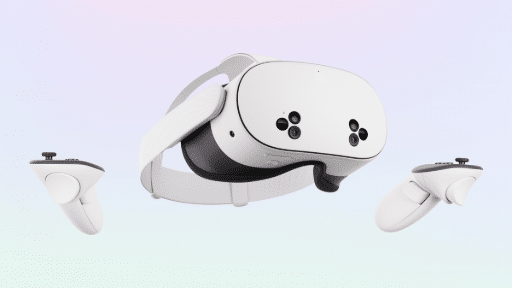
The biggest roadblock for mixed reality right now is raw local compute power. Standalone headsets simply don’t have the internal chips to hit the rapid refresh rates and massive stereo resolutions required for top-tier games. If you want to play anything truly demanding right now, it usually means tripping over a thick cable hooked up to a heavy PC or console. I remember dragging the PSVR2 cord across my living room and thinking about how much physical restriction that wire adds to the experience.
Slapping a more powerful processor into a wireless headset creates immediate heat and battery drain issues. The math just doesn’t work in our favour right now. We can’t pack a PlayStation 5 chip into a plastic frame that sits on the bridge of your nose. Something has to give, and rather than compromising on visual quality, the NYU and Sony team realized they could exploit how the human eye actually works.
How 3D Gaussian Splatting Changes the Math
To fix this bottleneck, the researchers utilize 3D Gaussian Splatting (3DGS). Instead of building a scene using traditional flat polygons, this technique uses packed point clouds. Think of them as tiny, semi-transparent blobs of colour, light, and geometry. Because these blobs don’t require traditional ray-marching processing, the rendering speed goes through the roof.
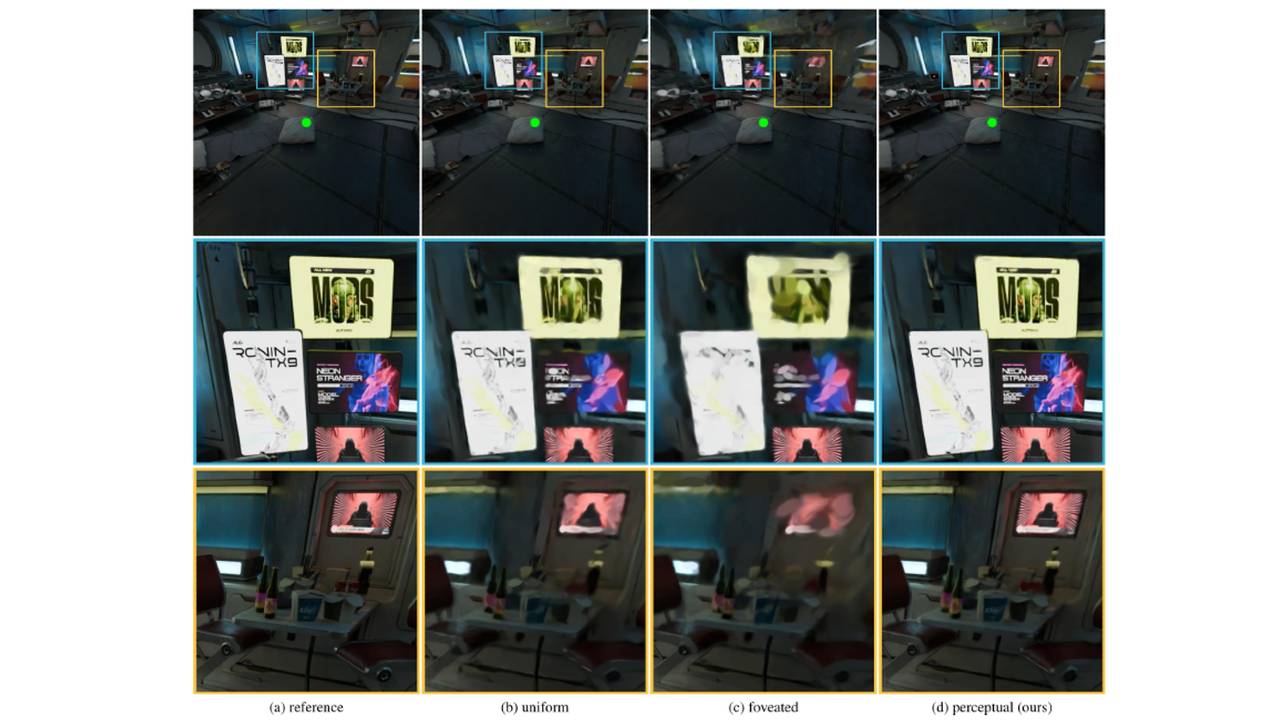
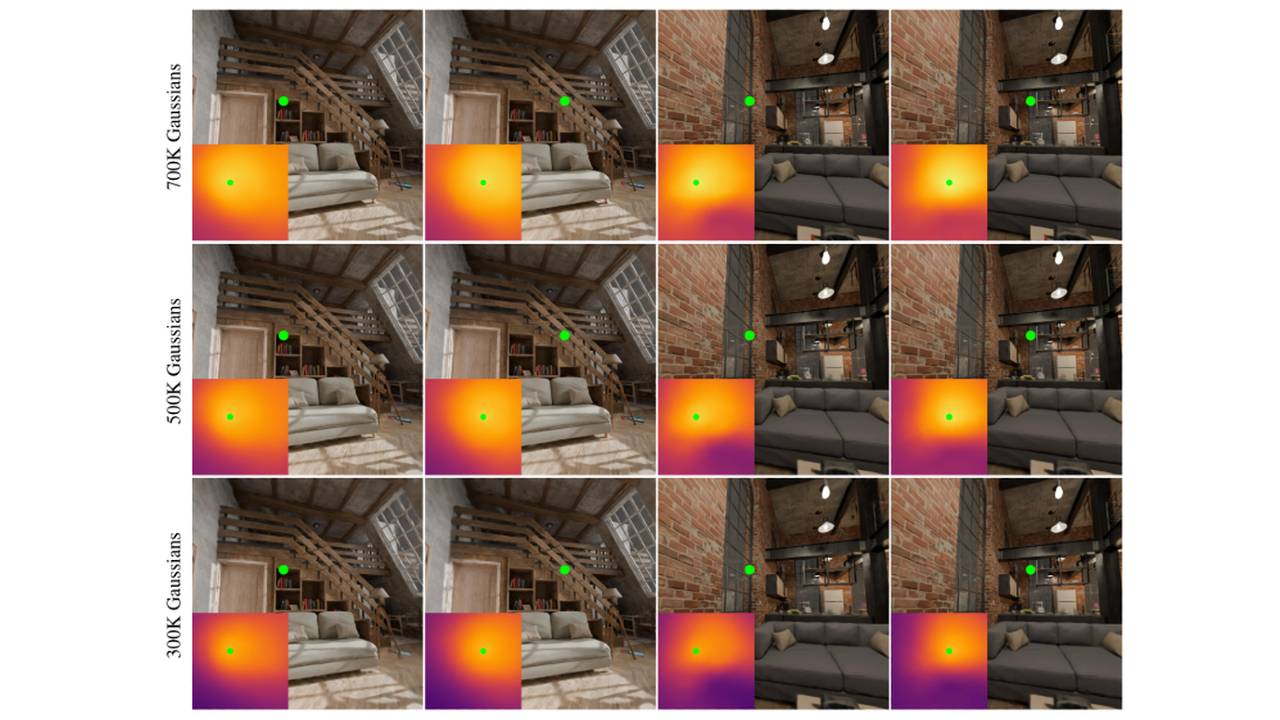
The researchers found a way to organize these blobs hierarchically. They can group smaller ones together to show incredible detail when you look closely, and use larger, simpler blobs for the background. The paper notes that a reference render uses about 2.56 million of these Gaussians, which crushes local processors. Their new method slashes that requirement down to just 300,000 to 700,000 Gaussians depending on the headset’s available power.
The Eye-Tracking Secret Weapon
The real magic happens when they tie this point cloud tech directly into human biology. We only see sharp details in the direct centre of our vision. Our peripheral vision naturally blurs out. The paper leverages this biological quirk by tracking exactly where your eyes are pointing.

Instead of rendering the entire 360-degree environment at maximum quality, the server calculates the exact level of detail needed for your specific field of view in real-time. The researchers use a visual quality metric to measure “Just-Objectionable Differences” (JODs). Basically, the algorithm asks: can a human actually notice if we lower the quality in the corner of their eye? If the answer is no, the cloud strips out that unnecessary data before sending it. It is a brilliant way to cut bandwidth without you ever realizing the graphics were downgraded in your periphery.
Splitting the Work Between Server and Headset
This is where the edge-cloud collaborative pipeline comes in. It doesn’t make sense to process a flat video stream remotely and deal with brutal video compression artifacts in VR. Traditional video streaming works great for standard screens, but VR requires something different.
Instead, the server does the heavy calculation on the point clouds, packages exactly what your eyes need, and sends over a binary mask telling the headset exactly what to draw. Your headset’s local processor handles the final display work. The researchers noted this hybrid approach drops the computation load by up to 75 percent. Crucially, the headset handles the final visual frame locally in about 3.02 milliseconds. That keeps everything well under the 11-millisecond limit needed for a 90Hz VR display.
Future Ambitions for PlayStation Cloud
When I dug into the technical data, my immediate thought went straight to the future of PlayStation Cloud. This isn’t just some academic curiosity; Sony directly funded this research through a SONY Focused Research Award and put three of their own engineers on the project. That is a big sign that they are hunting for a way to ditch the cable on future headsets without sacrificing the 4K fidelity we expect from a console experience.
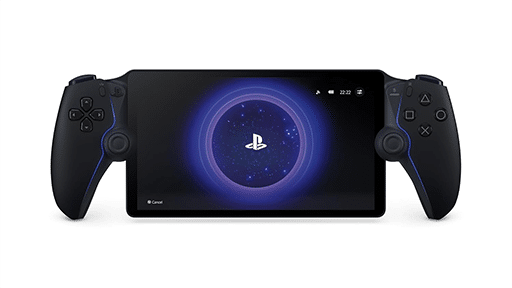
We have already seen Sony’s pivot in real-time. They’ve been pushing the PlayStation Portal to become more than just a remote-play accessory, evolving it into a legitimate standalone cloud device. When you pair that momentum with their work on Project Amethyst, you see a clear picture: Sony wants to move the “brain” of the console into the data centre.
Streaming high-fidelity games to an untethered VR device suddenly looks a lot more viable when the server only has to send a fraction of the environment data. The industry went quiet on wireless VR innovation lately. This was mostly because the battery and heat limitations felt like a dead end. This paper proves the background work is still happening in the shadows. Separating the intense processing from the device on your face is the “holy grail” for this tech, and this edge-cloud framework might be the exact path Sony takes to deliver a wireless VR tier for PlayStation Plus Premium users.
As always, remember to follow us on our social media platforms (e.g., Threads, X (Twitter), Bluesky, YouTube, and Facebook) to stay up-to-date with the latest news. This website contains affiliate links. We may receive a commission when you click on these links and make a purchase, at no extra cost to you. We are an independent site, and the opinions expressed here are our own.