


Cloud gaming and AI are suddenly being talked about in the same breath. Power limits, GPU shortages, cooling constraints, and data center capacity are all becoming mainstream talking points as artificial intelligence workloads continue to grow.
What’s interesting is that cloud gaming has been dealing with many of these problems for years. A recent interview with Boosteroid’s infrastructure leadership offers a clear look at why that is. While the conversation focused on how Boosteroid operates its global cloud gaming platform, much of what was discussed applies directly to the challenges AI companies are only now beginning to face.

If anything, it highlights how cloud gaming quietly became a stress test for modern compute infrastructure long before AI made it fashionable.
Cloud Gaming Was Built Around Constraints
Cloud gaming never had the luxury of excess. From the beginning, platforms like Boosteroid had to solve problems around latency, power density, cooling, and global deployment while still keeping costs under control. Unlike many enterprise or AI projects, cloud gaming had to work at scale from day one and in real time, with players noticing immediately if something went wrong.
That meant designing infrastructure around efficiency rather than brute force. Where traditional data centres could afford to overprovision, cloud gaming could not. Every rack, every watt, and every cooling decision had a direct impact on performance and cost. Those limitations shaped how platforms expanded and where they chose to operate.
That same set of constraints is now catching up with the AI industry.
Data Centre Selection Matters More Than Ever
One of the clearest takeaways from Boosteroid’s comments is how misleading data centre specifications can be on paper. Not all facilities that claim high capacity can actually support sustained high-density workloads.

Power delivery, cooling design, and real-world thermal performance vary widely, even among centres that advertise similar ratings. For cloud gaming, this has always been a deciding factor. GPU-heavy workloads generate consistent heat and demand stable performance. A facility that cannot handle that reliably becomes unusable, regardless of how attractive its pricing looks.
This is now becoming a common issue for AI deployments as well. High-density GPU racks are pushing beyond what many traditional data centres were designed to handle. Power availability is only part of the equation. Cooling and airflow are often the real limiting factors.
The Shift Toward High-Density and Modular Infrastructure
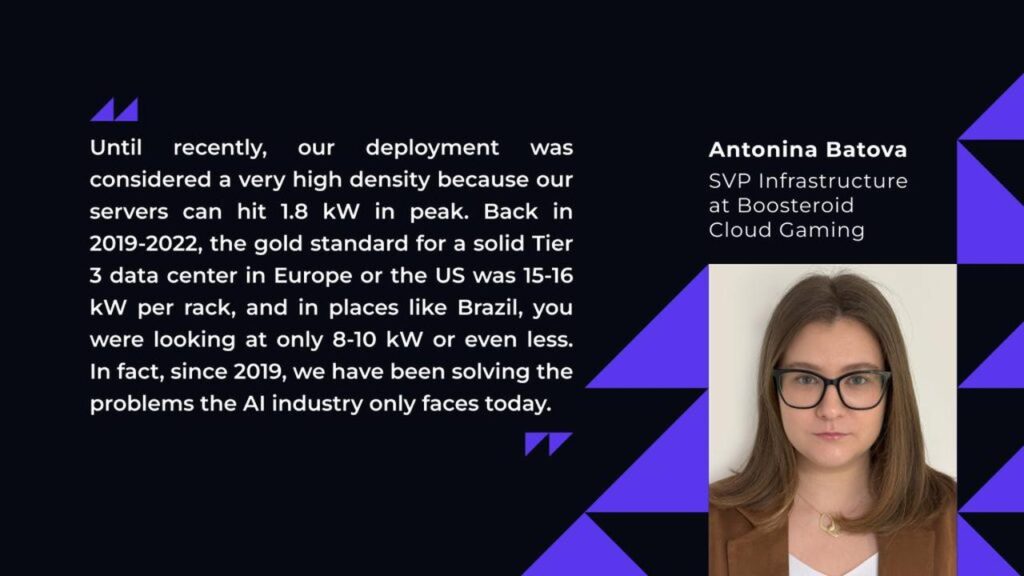
One of the more revealing points from Boosteroid’s infrastructure team is how quickly expectations have changed. A few years ago, a 15 to 20 kW rack was considered high-end. Today, AI-focused deployments are pushing well beyond that, often requiring liquid cooling and specialized layouts. Many facilities simply were not built for this level of demand.
This has driven a growing shift toward modular and containerized data centres. These setups allow companies to deploy high-density compute faster and with more predictable performance, even if they are not ideal long-term solutions.
Cloud gaming providers were early adopters of this approach out of necessity. AI companies are now following the same path, but at a much larger scale.
AI Is Running Into the Same Wall Cloud Gaming Hit First
The challenges AI companies are facing now will sound familiar if you have followed cloud gaming over the past few years. Hardware availability is limited. Power delivery is a bottleneck. Cooling infrastructure is expensive and slow to upgrade. Deployment timelines are longer than most companies expect.
The difference is timing. Cloud gaming had to solve these problems quietly while proving that the model worked. AI is encountering them in the spotlight, with far more capital involved and much higher expectations attached.

In both cases, the real constraint is not innovation. It is infrastructure.
Timing Is the Real Risk
One of the most important points raised in the Boosteroid interview is how critical timing has become. Ordering GPUs too early can leave companies paying for unused data centre space. Ordering too late can delay launches by months. In a market where hardware availability is tight and demand keeps rising, that balance is increasingly difficult to manage.
This is where cloud gaming experience matters. Operating at scale forces companies to think several steps ahead, not just about hardware, but about power contracts, cooling capacity, and long-term sustainability. That discipline is now becoming essential for AI-focused businesses as well.
The Reality Behind Cloud Gaming Infrastructure
For cloud gaming, this moment is both a challenge and an opportunity. Expansion is likely to remain measured rather than explosive. Infrastructure limitations make rapid global rollouts difficult, but they also reward companies that plan carefully and invest in the right places.
It also reinforces something that has been true for a long time. Cloud gaming success is not just about performance or library size. It is about infrastructure decisions made years in advance. As AI continues to reshape the tech landscape, cloud gaming’s early struggles with power, density, and scale are starting to look less like growing pains and more like preparation.
The future of both industries will be decided not by ambition alone, but by who can build and maintain systems that actually work at scale.
As always, remember to follow us on our social media platforms (e.g., Threads, X (Twitter), Bluesky, YouTube, and Facebook) to stay up-to-date with the latest news. This website contains affiliate links. We may receive a commission when you click on these links and make a purchase, at no extra cost to you. We are an independent site, and the opinions expressed here are our own.