


I tried these five tips to optimize my cloud gaming experience, and they genuinely worked. So much so that I applied to become a writer at Cloud Dosage–
Oh. Wait… Ignore that.
Anyways, my editor is completely unaware that this little listicle resembles the move your router to the left to get NASA’s internet speed tipsicle.
Therefore, I present you my own little listicle tipsicle (I am aware of the potential for a Freudian double entendre, thank you very much).
TIP 1: Choices Matter (Usually)

I have enough cloud gaming subscriptions to establish diplomatic relations with several small countries, and I still spend twenty minutes to seven days deciding what to play.
In theory, having more options should make choosing a game easier.
But practically? It’s akin to diving into Dante’s The Divine Comedy and discovering there are seven extra levels of hell with a boss fight at the end.
Some subscriptions overlap, others collide, and several merely exist because, you know, existence.
You don’t need seven versions of Assassin’s Creed: Pirate Flag Deluxe Upgrade All DLC EVER RELEASED.
And you definitely don’t need four versions of a game’s Deluxe Deluxe Edition Clothing New Cats Car Deluxe Super Unicorn Outfit Deluxe Edition.
You need space.
Seriously.
Cloud gaming platforms have a tendency to become somewhat clingy.
TIP 2: Please Pass Passes (Safely)
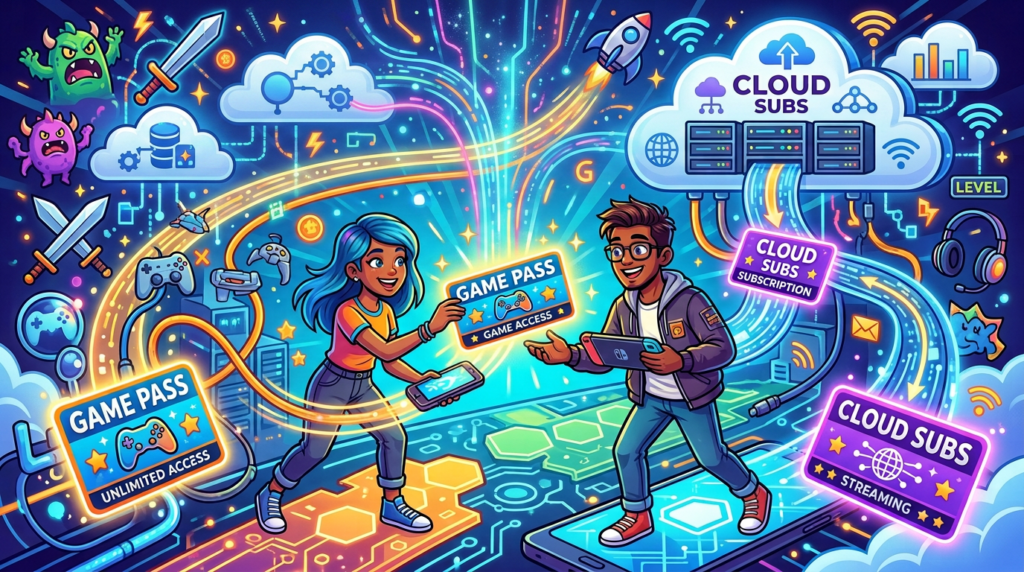
At some point, cloud gaming subscriptions stopped being subscriptions and became a collection of increasingly expensive passes, tiers, bundles, and premium versions of things I thought I had already paid for.
Game Pass, publisher passes, premium passes, ultimate passes, a Pass Pass, a Plus Pass Premium Pass, and the spectacularly original Amazon Luna+.
Plus the passes that allow me to pay for the privilege of accessing the pass I already paid for.
It’s the ouroboros of gaming.
But this is when things get expensive. Not necessarily because any individual subscription costs too much, but because marketing departments are very good at convincing us that we need every single subscription in the known universe.
Before long, you’re paying for six different services because each one has three games you want, while spending your evening trying to remember which subscription actually contains them.
This is where the Red Queen Hypothesis comes in, but with fewer rabbits and Darwinism and moths.

Always moths.
The basic idea is that everyone has to keep moving just to stay in the same place. One company introduces something new, another copies it, the first responds, and suddenly everyone is adding new features, tiers and products simply because everyone else is doing it too.
Cloud gaming has developed its own version of this. One service introduces a new pass, another launches a competing one, and suddenly we’re all standing in front of a wall of subscriptions wondering why accessing one game requires a minor understanding of international economics.
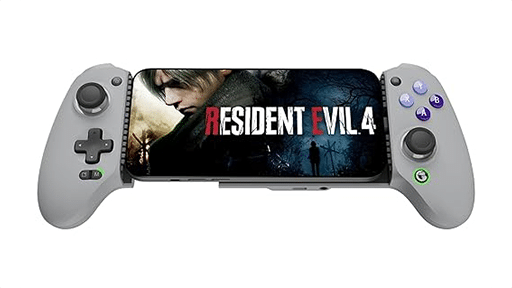
So, don’t be Alice and jump down that rabbit hole… Choose a couple of passes, try them out, and move on.
Or keep them.
But be careful… Off with their heads is a thing.
And we don’t need another free pass to the guillotine.
TIP 3: VPN ≠ Magical Portal

There appears to be a widespread belief that a VPN is some kind of magical portal through which the laws of geography, corporate policy, and, occasionally, physics can be politely asked to fuck off.
It isn’t.
If a cloud gaming service isn’t available in your country, connecting to a VPN server somewhere else does not suddenly make the service available. You haven’t moved. The server hasn’t moved. The company’s regional infrastructure hasn’t moved. The only thing that moved was your IP address.
And yet, somehow, the VPN industry has convinced us that this is basically teleportation.
Want to use Boosteroid in a country where Boosteroid isn’t officially available? Simply connect to a server in Germany. Or France. Or America. Or, for reasons known only to you and your increasingly desperate gaming library, some obscure location you selected because it sounded vaguely European.
Congratulations.
You are now pretending to be somewhere else.
You are not actually there.
This is particularly useful if you happen to live somewhere like Nauru, where your nearest cloud gaming infrastructure may be separated from you by an alarming quantity of Pacific Ocean. A VPN cannot simply look at that ocean and say, “No thank you,” before folding spacetime in half and delivering your game directly to your television.
The packet still has to travel.
Physics remains undefeated.
And even if a VPN does allow you to connect to a service, that doesn’t mean you’re going to get a magical gaming experience. You may simply have succeeded in adding another stop to the journey between you and the server, which is a fascinating way of spending money to make latency worse.
So use a VPN when you actually need one.
Just don’t expect it to turn an unsupported country into a supported one, turn an ocean into a LAN cable, or convince a cloud gaming provider that you have suddenly relocated your entire household to Frankfurt.
It is a VPN.
Not a wormhole.
NASA remains strangely uninvolved.
TIP 4 & 5: We Ran Out of Tips, So Choose Wisely

Okay, I’m cheating.
Tips four and five have been combined because five tips seemed excessive, and frankly, the cloud gaming industry already has enough excess.
At some point, you have to stop subscribing to every cloud gaming service because you saw one game you wanted to play.
You do not need an entirely new subscription because you suddenly developed an overwhelming desire to play Call of Duty: Black Ops Cold War Modern Warfare Warzone 2.0 Deluxe Vault Ultimate Operator Bundle Edition.
You probably already own it.
In fact, you may own it twice.
You may have the Standard Edition on Xbox Cloud Gaming, the Deluxe Edition on GeForce NOW, and the Ultimate Super Mega Please Give Us More Money Edition on another service you subscribed to at two in the morning because apparently sleep is for people who haven’t discovered cloud gaming.
And then you discover that the only difference between the three versions is a digital hat.
A very nice hat.
Possibly.
I don’t know.
I’ve spent money on worse things.
I’ve also bought games I already owned.
More than once.
I’ll see something I want to play, subscribe to another service, and then discover that the bloody thing is already sitting in my library somewhere else.
Sometimes it’s on GeForce NOW.
Sometimes it’s on Xbox Cloud Gaming.
Sometimes it’s on another service I apparently subscribed to during an episode of temporary financial amnesia.
And sometimes I own the game on two services and still manage to buy it again.
At this point, I could probably run a small cloud gaming service entirely from the games I have accidentally purchased.
It would have three customers.
None of them would know where the login details are.
This is where the Red Queen Hypothesis wanders back into the room wearing someone else’s trousers. Everyone is running faster, adding more services, more tiers, more libraries and more ways to access the same games, while I’m standing in my living room trying to remember whether I bought Assassin’s Creed or merely spent forty minutes looking at it.
And this is why you should check your catalogue before subscribing to anything new.
Actually check it.
Pick one or two services that actually suit you. Try them. If they don’t work, switch.
You do not need to collect cloud gaming subscriptions like Pokémon.
You certainly don’t need to catch them all.
You just need to play the bloody games.
Otherwise, you’ll eventually reach the point where you’re paying for six cloud gaming services, owning four versions of the same game, and standing outside your own house waiting for a mime without teeth to explain your subscription strategy to you.
And frankly, he probably knows more about it than you do.
That’s five tips.
Technically.
Please don’t count them.