
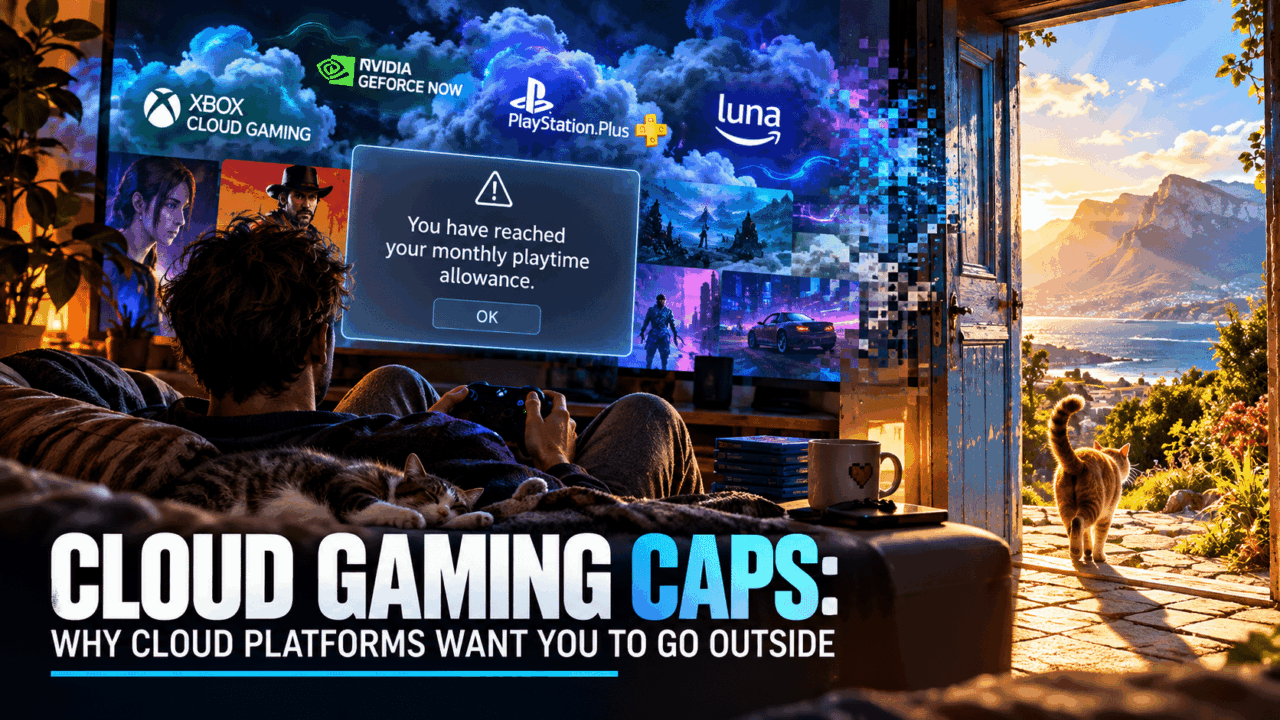
I was minding my own business, chilling like a villain, streaming games without having to sell an organ to buy a high-end gaming PC, when my cloud gaming service sent me a notification.
“You have reached your monthly playtime allowance.”

Right. Fantastic.
I also reach people’s monthly emotional limit allowance, but that’s for my therapist to figure out.
So, using a cloud gaming subscription to stream GTA XII isn’t viewed as a win-win by cloud platforms. It’s viewed as an intolerable strain on their server farms.
Fun fact—a server farm is also known as a server nursery. It’s where baby servers become big servers and eventually graduate from server colleges.
Slap me with a pogo stick..
We’re officially living in the era of cloud gaming playtime caps.
It’s a bit like the Roman Empire, but with less Nero and fires and gladiator people doing things that make other gladiator people dead.

Cloudy with a Chance of Time Debt
If you’ve ever used services like GeForce NOW or Xbox Cloud Gaming, you know the dream: no huge console, no $1,000 graphics card, just log in and stream.
It’s like discovering a new drag name. Mine include Tina Toner and Better Middler amongst others.
But these platforms tend to assume that hours spent playing games is a strictly rationed commodity; somewhere between fresh drinking water and my own remaining threads of sanity.
Instead of your internet provider throttling your connection, the cloud services themselves are now dropping the hammer:
You pay for a monthly subscription expecting unlimited playtime.
The cloud platform quietly institutes a strict monthly hour cap (say, 100 hours).
Midway through the month, the service politely informs you that any further gameplay will require waiting in endless queues, paying extra hourly fees, or taking up an offline hobby like origami.
It’s the digital equivalent of buying a gym membership, only for the gym to ban you from entering after week two because “you’re using the treadmills too much.”
Bridging to the Research (Because Server Racks Aren’t Free)
Rather than throwing my controller out the window, or trying to convince the cloud servers that I’ve physically transformed into three different people sharing one account, I did what any sane person would do.
I read the fine print.
I spent the last few weeks digging into the new cap policies, crunching the hourly limits, and analyzing how major platforms like GeForce NOW and Xbox Cloud Gaming are rationing game time for paying subscribers.
Below is the complete, unvarnished breakdown of my research—including the actual numbers, the hidden restrictions, and whether you need to start dusting off physical board games just to survive the end of the month…
Never trust the family member who promises they don’t cheat during a seven-decade session of Monopoly.
I see you, Cousin Greg… I see you!




Then There’s the Geographic Thingamajiggy
Because apparently the cloud has borders. Not literal borders, obviously. We haven’t built a tiny customs checkpoint inside the internet yet. But where you live can make a surprisingly big difference to which cloud-gaming services you can actually use, what they cost, which servers you connect to, and whether the whole experience is silky smooth or feels like your controller is communicating with a satellite on Mars.
Take South Africa, where I happen to be sitting while writing this. GeForce NOW has a South African service arrangement through Rain, with local infrastructure, while Blacknut has also been building local infrastructure support through Vodacom Business. Meanwhile, other major services may be available differently, routed differently, or not officially supported at all.
So that raises a rather awkward question.
If cloud gaming is supposed to be cloud gaming, why does geography matter so much?
The answer isn’t simply internet speed. The location of the servers matters. The infrastructure behind those servers matters. Local partnerships matter. Data-center capacity matters. Licensing matters. And, presumably, somebody somewhere has to pay for all the enormous computers doing the actual gaming.
Which brings us back to the caps.
Because if companies are suddenly telling paying customers that they can only use a certain number of hours of cloud gaming each month, I want to know whether that is an industry-wide infrastructure problem, a pricing decision, a capacity problem, or some magnificent combination of all three.
And, frankly, I have questions.

Why Are the Caps Happening?
Cloud gaming is not just a subscription that magically turns a game into a video stream. Every time you play, a remote computer has to run the game for you, render the graphics, encode the video, send that video across the network, and respond to your inputs.
That means every hour of play consumes real computing capacity. The more people play, and the longer they play, the more capacity a provider has to keep available.
The companies are approaching that problem in very different ways. Some are putting a hard number of hours into the subscription and selling additional time. Some reduce access after the allowance is used. Others continue to offer unlimited playtime and have chosen a different way of absorbing or pricing those costs.
Microsoft has explicitly tied its upcoming Xbox Cloud Gaming limits to the rising cost of providing cloud gaming as usage increases. NVIDIA, meanwhile, says its one-hundred-hour allowance is intended to help maintain quality, speed, and shorter queues.
So this isn’t one giant industry-wide switch being flipped at the same time. It is a collection of companies making different decisions about how much cloud computing their subscriptions include, how much heavy users should pay, and how much capacity they want to reserve for everyone else.
And that is where things get interesting.
So, Who Actually Has a Cap?
Here is the quick-reference version. The table deliberately distinguishes between an actual published limit and a service that simply has not published one. No published cap does not automatically mean unlimited.
What This Actually Means
The important thing here is that there isn’t one universal cloud-gaming cap. There are several different models operating at the same time.
Some providers meter playtime directly. Some offer a large monthly allowance and then sell additional hours. Some pause or downgrade access when the allowance is exhausted. And some still offer unlimited playtime.
So the real story isn’t simply that cloud gaming has suddenly decided to hate fun.
The more interesting question is why these companies have made such different choices, and whether the limits we are seeing are the beginning of a broader shift in how cloud gaming is priced.

Why Do People Wear Caps?
I don’t know. But I don’t wear caps or strange hats because they make my face look like a sad egg someone abandoned at the supermarket.
Someone needs to cap my fingermouths aka fingers have mouths when they type because text and—
I digress.
The r/cloudgaming community thread thingy is inundated with frustrated gamers, hate-trolls and the ubiquitous take-it-or-leave-it diplomat in the room.
“Listen, if you have an issue with caps, then I suggest you buy a PS7/Xbox Series TARDIS or deal with itttttttttt!”
One Redditor posted:
“Obviously, as of November, the changes for xbox [sic] Cloud gaming will be implemented. I play Fortnite a lot on cloud gaming as it’s my only way to play. I use a very crappy Chromebook that [can’t] play Fortnite regularly even if I wish. I have [the Essential Xbox Game Pass tier] only really for unlimited time but as of now I’m [sic] screwed. I play easily over 50 [hours] a month so I’ll be [running] dry by no time. [The] worst part is [that] I have no income either for a console. Is there anything I can [use as a] substitute or am I just screwed?”
And that, my dear Reddit friend, is a question I wish I had an answer for.

Clapping Capped Clowns
Is this the end of the world as we know it? Don’t they know it’s the end of the world when cloud gaming says goodbye? Why do capped clouds suddenly appear?
Important questions asked by REM, Skeeter Davis and The Carpenters.
(I wanted to appear intellectual and quote Kierkegaard or Albert Camus, but this isn’t the time for jokes)
Alas, the future is not ours to see, so send in the clowns and let’s cross this bridge over very troubled waters.
Together.
As always, remember to follow us on our social media platforms (e.g., Threads, X (Twitter), Bluesky, YouTube, and Facebook) to stay up-to-date with the latest news. This website contains affiliate links. We may receive a commission when you click on these links and make a purchase, at no extra cost to you. We are an independent site, and the opinions expressed here are our own.